Fill power chart: what the numbers mean
| Fill power | Down quality tier | Practical feel |
|---|---|---|
| 400–500 | Entry-level | Heavier for the warmth; more down needed |
| 550–650 | Good, mainstream | The value sweet spot for most sleepers |
| 700–750 | Very good | Noticeably lighter drape at equal warmth |
| 800–850 | Excellent | Very light, very lofty; premium pricing |
| 900–1000+ | Rare / specialty | Diminishing returns; verify certification |
Quick answer: Fill power measures how many cubic inches one ounce of down expands to fill — 600 fill power down lofts to 600 cubic inches per ounce, 850 lofts to 850. Higher fill power means more warmth from less down, so the comforter feels lighter and drapes better at the same warmth level. It is a measure of down quality, not of how warm the finished comforter is — that depends on fill power and fill weight together.
That last sentence is the part most shopping guides skip, and it's the part that actually saves you money. A 600 fill power comforter stuffed with plenty of down can be warmer than an 850 fill power comforter with a light fill weight. Fill power tells you how efficiently the down traps air. Fill weight (ounces of down in the shell) tells you how much of that trapping is going on.
Fill power above roughly 800 comes from mature, cold-climate waterfowl with large down clusters. There is genuinely less of it in the world, which is why the price curve gets steep. If you see a 1000 fill power comforter priced like a 600, be skeptical — the number is unregulated in casual marketing, and independent standards bodies (IDFB, USDA) exist precisely because claims drift.
Finding the right what is fill power in comforter comes down to matching the features to how you will actually use it.
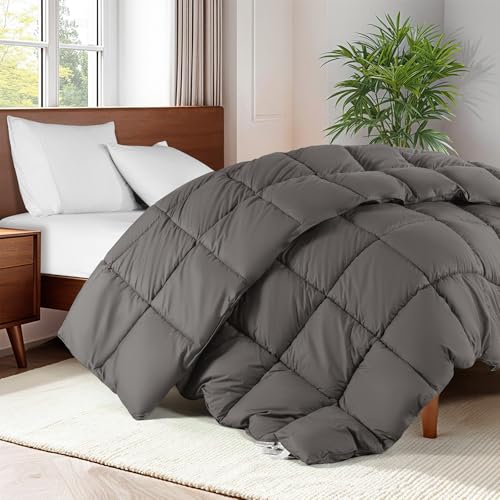
- Ultra-Soft 850 Fill Power: Indulge in the exceptional loft and softness of our premium duvet insert, generously filled with 75% Canadian white goose down. With an outstanding 850
- 100% Pure Cotton: Crafted from 100% pure cotton with a smooth 600-thread count, this duvet offers a refined touch that is both lightweight and durable. The tightly woven cotton
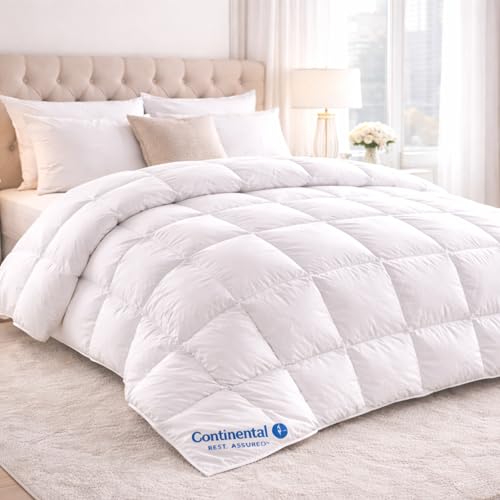
- Hungarian White Goose Down Luxury Fill: Filled with premium Hungarian white goose down, known for superior softness, purity, and resilience. The 700 fill power delivers high loft
- Baffle Box Construction for Even Loft: True baffle box design uses internal fabric walls that allow the down to fully expand while preventing cold spots. This construction ensures
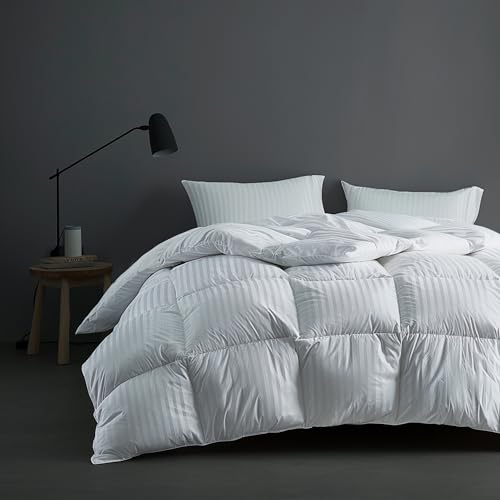
- 【Presidential Suite Elite Fluffy Duvet Insert】- Cultivated in the icy regions of North Latitude 37, our down comforter stands apart with a unique cultivation period exceeding 180
- 【Premium Down Comforter Material】Good sleep hygiene is crucial for quality rest. To ensure this, we meticulously manage breeding density and maintain spotless poultry farms
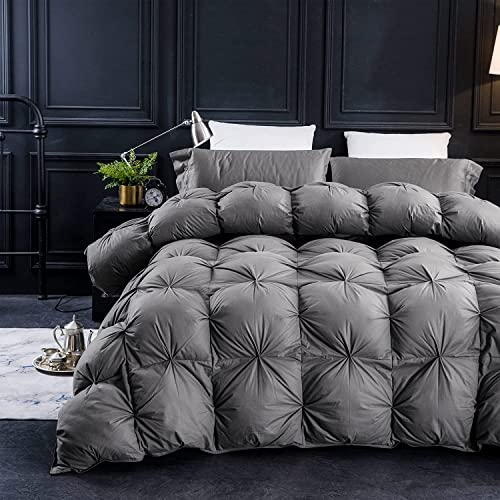
- Rest easy knowing that this cozy comforter is filled with ethically sourced waterfowl feathers and down for a comfortable and responsible night's sleep
- Designed as a King size:106x90 inches, 72oz fill weight, medium-warmth comforter to keep you cozy all year. Dry clean or professionally launder
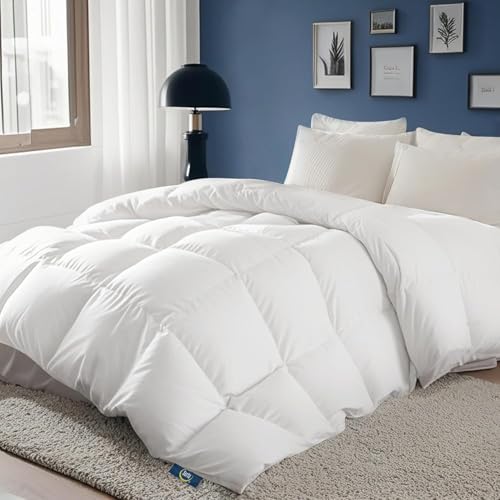
- 【Certified Hypoallergenic Down Fill】 – Filled with premium 75% European white down and 25% feathers, this down and feather fill offers superior temperature regulation, enhanced
- 【Skin-Friendly Softness】 – Crafted from 100% cotton with a 300-thread count, this fabric is smooth, breathable, and gentle on the skin—delivering a luxurious and comfortable
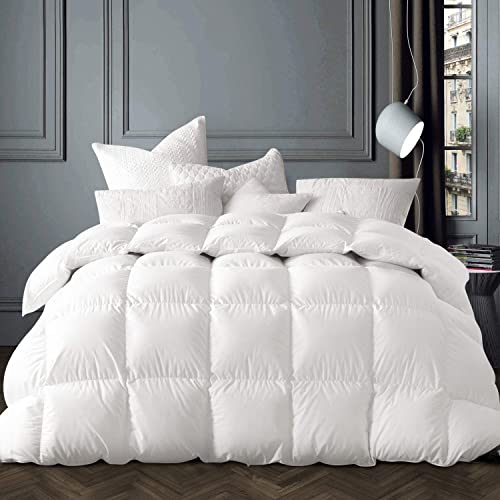
- [LUXURIOUSLY SOFT&NOISELESS]: 420 thread count 100% skin friendly shell. It's soft to touched and noiseless.Let you enjoy a full night of peaceful sleep
- [EXTRAORDINARY MOISTURE WICKING] Filled with Texcote-Nano Treated premium white goose down and feathers making our down duvet moisture repellent, quick-drying, and 3 times more
The products in this guide, side by side
| Product | Stated fill power | Fill | Shell | Size / fill weight | Price |
|---|---|---|---|---|---|
| THX9ZRNM 75% Canadian Goose Down Comforter King Size | 850 | 75% Canadian white goose down | 100% cotton, 600 TC | King 106" x 90" / Not stated | Check price on Amazon |
| Continental Bedding Serenity Hungarian White Goose Down Comforter | 700 | Hungarian white goose down, RDS | 100% cotton sateen, 400 TC | King 102" x 86" / Not stated | Check price on Amazon |
| Hotel Grand Luxury White Down Comforter King Size | 600 in title; 650 in description; 75%+ white down | White down | 100% cotton damask stripe, 500 TC | King 106" x 90" / Not stated | Check price on Amazon |
| Three Geese Pinch Pleat Waterfowl Feathers and Down Comforter King Size | 750+ | Waterfowl feathers and down | 100% cotton, 1200 TC | King 106" x 90" / 72 oz | Check price on Amazon |
| Serta Luxury European Down Comforter Queen Size | 600 | 75% European white down, 25% feathers, OEKO-TEX | 100% cotton, 300 TC | Queen / Not stated | Check price on Amazon |
| Globon Winter Goose Down Comforter King Size | 800+ | White goose down and feathers, RDS + OEKO-TEX 100 | 420 TC shell | King / Not stated | Check price on Amazon |
Two things jump out of that table. First, only one product here — the Three Geese Pinch Pleat Waterfowl Feathers and Down Comforter King Size — publishes a fill weight (72 oz). Everyone else gives you fill power and expects you to infer warmth from it. You can't, reliably. Second, the Hotel Grand listing says 600 fill power in the title and 650 in the bullet description. That kind of inconsistency is worth noticing before you buy, not after.
Who fill power actually matters for
You run cold and hate weight on your chest. This is the single best reason to pay for high fill power. Higher-loft down gives you the same insulation with fewer ounces sitting on your body. If you've ever said "I want to be warm but I feel trapped," you want 700+.
You're buying a winter-weight comforter. Warmth targets get heavy fast at low fill power. The Globon Winter Goose Down Comforter King Size at 800+ fill power is built for exactly this trade: cold-weather warmth without the anvil effect.
You want the thing to last a decade. Larger down clusters resist breaking down and compacting. Higher fill power tends to hold loft longer through years of compression, which is a real durability argument, not just a comfort one.
You sleep hot and want summer-weight down. Counterintuitively, high fill power helps here too — the Continental Bedding Serenity Hungarian White Goose Down Comforter uses 700 fill power at a deliberately light fill weight so you get airflow and drape without a heat trap.
Who should skip the fill power chase
Anyone on a budget who just wants a warm bed. A 600 fill power comforter with generous fill weight will keep you warm. It'll be heavier. That's the whole penalty. The Serta Luxury European Down Comforter Queen Size sits right in this territory at 600 fill power with a 75/25 down-and-feather blend.
People with dust or feather sensitivities. Fill power is irrelevant to you compared to shell tightness, washability, and certification. Look at thread count and down-proofing instead — and note that both the Serta and the Globon list OEKO-TEX certification.
Anyone who can't dry clean. Almost every product here specifies dry clean or professional laundering. If you need a machine-washable bed layer, down is the wrong category, regardless of fill power.
Guest rooms and kids' beds. Nobody sleeping in your guest room three nights a year will notice 850 vs 600. Spend the difference elsewhere.
The honest trade-offs
Fill power is not warmth. I'll say it a third time because the marketing works so hard to blur it. Ask for fill weight in ounces. If the listing doesn't state it, you are guessing.
"Down comforter" often means down and feathers. Feathers have quills. They add weight and can poke through the shell, and they lower the effective loft. The Three Geese product is explicitly a feather-and-down blend at 750+ fill power with 72 oz of fill — that combination tells you it's a substantial comforter, not an airy one. The Serta discloses 25% feathers. Read the percentage, not just the headline number.
Fill power claims are self-reported. There's no mandatory audit on an Amazon listing. RDS certification (Continental Bedding, Globon) speaks to sourcing ethics, and OEKO-TEX (Serta, Globon) speaks to chemical safety — neither one verifies the fill power number. Certifications are still a decent proxy for a supplier that takes testing seriously.
Shell construction can beat fill power. Baffle box construction uses internal fabric walls so down can fully expand; sewn-through box stitching pinches the loft at every seam and creates cold lines. Continental Bedding, Hotel Grand, Serta, and Globon all specify baffle or 3D box designs. The THX9ZRNM specifies box stitching. At the same fill power, baffles win.
Price does not track fill power linearly. The most expensive comforter listed here is 700 fill power; the cheapest is claimed at 850. Construction, origin, brand, and shell quality move price at least as much as the down grade does.
What to check on the listing before you buy
Listings change constantly — specs, prices, and even the fill inside a given ASIN can shift between production runs. Before you commit:
- Current price and size variant. Prices quoted here are snapshots. Confirm the size you're selecting is the one priced — king and queen often share a listing at very different prices.
- Fill weight in ounces, if stated anywhere. This is the number that tells you warmth.
- Fill power consistency between the title, the bullets, and the A+ content. The Hotel Grand listing showing both 600 and 650 is a good example of why you check.
- Down vs. down-and-feather percentage, spelled out.
- Construction: baffle box vs. sewn-through.
- Care instructions. Most of these say dry clean only.
- Warranty and return window. Down needs a few days out of the box to reach full loft; make sure your return window outlasts that.
- Recent reviews, especially any mentioning feather leakage or loft collapse. Go read them yourself — sort by most recent, not most helpful.
Consider instead if…
THX9ZRNM 75% Canadian Goose Down Comforter King Size, 100% Cotton Shell — consider instead if…
…you want the highest stated fill power at the lowest entry price. The THX9ZRNM 75% Canadian Goose Down Comforter King Size, 100% Cotton Shell claims 850 fill power with 75% Canadian white goose down and a 600 thread count cotton shell at $109.99. It uses box stitching rather than baffle box, and the fill weight isn't published — so treat the 850 as a claim to verify rather than a guarantee.
Continental Bedding Serenity Hungarian White Goose Down Comforter 700 Fill Power Summer Weight Baffle Box Construction 100% Cotton Shell Made in USA King Size 102 x 86 Inches — consider instead if…
…you sleep hot and want down anyway. The Continental Bedding Serenity Hungarian White Goose Down Comforter 700 Fill Power Summer Weight Baffle Box Construction 100% Cotton Shell Made in USA King Size 102 x 86 Inches pairs 700 fill power Hungarian white goose down with true baffle box walls and a deliberately light summer fill, in a 400 thread count cotton sateen shell. Made in New York with RDS-certified down. At $464.43 it's the priciest here by a wide margin.
Hotel Grand Luxury White Down Comforter King Size, 600 Fill Power All Season Down Duvet Insert King — consider instead if…
…you want hotel-style heft with 3D baffle box construction. The Hotel Grand Luxury White Down Comforter King Size, 600 Fill Power All Season Down Duvet Insert King, 500 Thread Count 100% Cotton Hotel Bedding Comforter with Stripe Pattern, Made in USA 106x90 Inch uses over 75% white down in a 500 thread count damask stripe cotton shell, with ADFC and OEKO-TEX certified filling made in the USA. Note the 600-vs-650 fill power discrepancy in the listing.
Three Geese Pinch Pleat Waterfowl Feathers and Down Comforter King Size Duvet Insert — consider instead if…
…you want the one product here that actually tells you its fill weight. The Three Geese Pinch Pleat Waterfowl Feathers and Down Comforter King Size Duvet Insert,750+ Fill Power,1200TC 100% Cotton, Premium All Seasons Gray Warm Hotel Comforter with 8 Tabs. states 72 oz of ethically sourced waterfowl feather and down fill at 750+ fill power, in a 1200 thread count cotton shell with double-needle stitching, for $145.98. It's a feather blend, so expect more weight than a pure-down equivalent.
Serta Luxury European Down Comforter Queen Size Duvet Insert, Made in USA — consider instead if…
…you need a queen and want certification over raw fill power numbers. The Serta Luxury European Down Comforter Queen Size Duvet Insert, Made in USA runs 600 fill power with 75% European white down and 25% feathers, OEKO-TEX certified, in a 300 thread count cotton shell with baffle-box construction, piped edges, and corner loops. Available in twin, full/queen, and king.
Globon Winter Goose Down Comforter King Size, 800 Fill Power Duvet Insert — consider instead if…
…you want a genuine winter-weight build at high fill power. The Globon Winter Goose Down Comforter King Size,800 Fill Power Duvet Insert uses 800+ fill power white goose down and feathers with a Texcote-Nano moisture-wicking treatment, a 420 thread count shell, 3D box design, 8 loops, and both RDS and OEKO-Tex Standard 100 certification, from a maker with 35 years in down.
FAQ
Is 1000 fill power worth it over 800? For most sleepers, no. The warmth-per-ounce gain from 800 to 1000 is real but small, while the price gap is large and the supply of genuinely 1000-rated down is tiny. If a 1000 fill power comforter is cheap, the number is the first thing I'd doubt. None of the comforters covered here claim 1000.
What fill power should I get for a cold bedroom? Look for 700–850 plus a stated winter or all-season fill weight. High fill power alone won't do it — a lightly filled 850 summer comforter will leave you cold. The Globon Winter Goose Down Comforter King Size is the explicitly winter-oriented option in this set at 800+.
Does fill power affect how long a comforter lasts? Indirectly, yes. Larger down clusters — which is what high fill power measures — resist compressing flat over years of use. But shell quality, construction, and how you care for it matter as much. A baffle-box 650 with a tight cotton shell can easily outlive a poorly built 850.
What's the difference between fill power and thread count? Fill power describes the down inside. Thread count describes the fabric shell around it. A high thread count shell (like the 1200 TC on the Three Geese or 600 TC on the THX9ZRNM) helps stop feathers migrating through the fabric, which is why down-proof shells tend to run tight. They measure completely unrelated things.
Related guides
- What Is a Good Thread Count for Sheets?
- Common Reasons Best bedding, blankets and sleep textiles - comforters, duvet covers, sheet sets, weighted blankets, mattress toppers, bed pillows, mattress protectors, throw blankets, quilts Gets Denied
- Step-by-Step Best bedding, blankets and sleep textiles - comforters, duvet covers, sheet sets, weighted blankets, mattress toppers, bed pillows, mattress protectors, throw blankets, quilts Process
Key Takeaways
- Choosing the right what is fill power in comforter means matching the key features to your specific needs and budget
- Read real customer reviews and check the return policy before you commit
- Compare value across models — the priciest option is not always the best fit